
INTERMEDIATE LEVEL
Trading Psychology: Beating FOMO and Revenge Trading
Every technique covered so far in this series, support and resistance, trend identification, moving averages and RSI, chart patterns, risk management, and position sizing, can be written down, studied, and even backtested with cold, mechanical precision. None of it matters if, in the actual moment of placing a trade, fear or greed quietly overrides the plan. Trading psychology is not a soft, secondary topic tacked onto the end of a technical analysis course; experienced traders consistently describe it as the difference between a strategy that works on paper and a strategy that actually makes money in a real account.
Why your brain is poorly suited to trading by default
Human decision-making evolved to handle physical threats and immediate, visible consequences, not abstract numbers ticking on a screen that represent real money gained or lost. Behavioral economists have documented specific, predictable biases that affect nearly everyone. Loss aversion describes the tendency to feel the pain of a loss roughly twice as intensely as the pleasure of an equivalent gain, which is exactly why holding a losing position past its stop, hoping it recovers, feels so natural even though it is usually destructive. Recency bias describes the tendency to overweight the most recent few trades when judging whether a strategy is working, which is why a short losing streak after months of success can convince a trader to abandon a sound approach right before it would have recovered.
FOMO, illustrated on a real chart
Fear of missing out, almost universally shortened to FOMO, is the discomfort of watching an asset move sharply without you and the urge to jump in immediately, frequently abandoning your own entry criteria in the process. The real SPY data from this series shows a textbook trigger for this feeling.
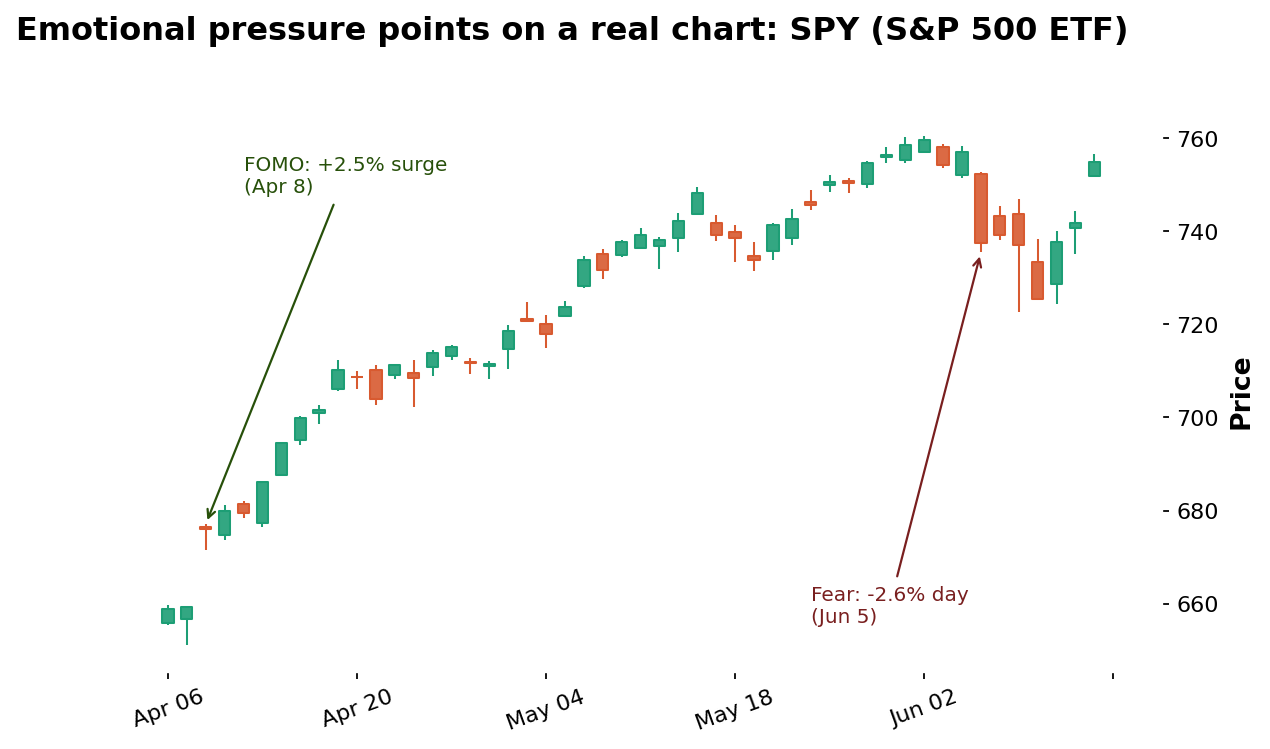
Data: stockanalysis.com (Tiingo), SPY daily candles, Apr 6 – Jun 15, 2026.
On April 8, SPY surged roughly 2.6 percent in a single session, a sharp recovery day that kicked off the powerful spring rally. A trader who had been on the sidelines, watching the market jump, would feel real, physical pressure to buy immediately, simply to participate in a move that suddenly looked unstoppable. This is precisely the moment FOMO causes the most damage: buying directly into a sharp, already-extended single-day move, often with no specific entry criteria beyond the discomfort of having missed the initial gain. A trader following the disciplined approach from earlier in this series, waiting for a pullback toward a rising trendline or support level rather than chasing the surge, would have had a defined process to fall back on instead of acting on pure emotional pressure.
Fear, illustrated on the same real chart
The opposite emotion shows up later in the same dataset. On June 5, SPY fell roughly 2.6 percent in a single session, a sharp, fear-inducing plunge after the market had spent weeks grinding higher. A trader holding a position into that decline, or considering a new long entry right as the selling accelerated, would feel real fear, the instinct to sell immediately or avoid the market entirely, exactly when a predetermined plan, not panic, should be making the decision. As the surrounding real data shows, the broad market stabilized and began recovering within days; the trader who sold purely out of fear with no plan, and the trader who held a clearly invalidated thesis with no stop-loss, both made decisions driven by emotion rather than process, just in opposite directions.
Revenge trading: the cycle that destroys accounts
Revenge trading describes the pattern of taking an impulsive, oversized, poorly planned trade immediately after a loss, driven by the urge to win the money back quickly rather than by any genuine setup on the chart. It is one of the most consistently destructive patterns in speculation because it compounds an ordinary, planned loss with a second, much larger, unplanned one, frequently taken with a position size far outside normal risk management, precisely when emotional control is at its weakest. A sharp down day like June 5 is exactly the kind of event that triggers it: a trader stopped out in the plunge might immediately pile back in at a larger size to recover, just as volatility is highest and judgment is worst. The defense is almost entirely procedural rather than willpower-based: a predetermined rule, decided in advance, to stop trading for the rest of the day or week after hitting a specific loss threshold, removes the decision from the moment when judgment is most compromised.
Overconfidence after a winning streak
The mirror image of revenge trading is overconfidence following a string of wins, which tends to produce gradually increasing position sizes, looser adherence to entry criteria, and a creeping sense that a winning streak reflects skill alone rather than a combination of skill and ordinary variance. The long, steady SPY rally through April and May is exactly the kind of environment that breeds this: weeks of nearly everything working can quietly convince a trader they have the market figured out, right up until a day like June 5 arrives. The position sizing article earlier in this series exists specifically to guard against this: a fixed percentage risk per trade, recalculated consistently regardless of recent results, prevents a winning streak from quietly turning into the oversized position that eventually meets a sharp reversal and gives back weeks of gains at once.
Confirmation bias and anchoring
Two additional biases consistently distort trading decisions. Confirmation bias is the tendency to notice and remember evidence supporting a position you already hold while unconsciously dismissing evidence against it, which can make a trader feel increasingly confident in a losing position exactly as the evidence against it accumulates. A trader long SPY through late May, for example, might focus heavily on the uptrend's intact higher-low structure while downplaying the deeply overbought RSI reading covered in the moving averages and RSI article, simply because the first piece of evidence was more comfortable. Anchoring is the tendency to fixate on a specific price, often the price you paid or a recent high, and judge all subsequent action relative to that anchor rather than objectively. A trader anchored to SPY's late-May high near $760 might have perceived the June dip toward $725 as a far more alarming collapse than the chart's actual structure warranted.
Building emotional resilience as a practiced habit, not a personality trait
It is tempting to assume some traders are simply born calmer and more disciplined, but the more accurate framing, supported by how consistently even experienced professionals describe their own early struggles, is that emotional discipline in trading is a built habit, not a fixed trait. Reviewing your trading journal after every session, specifically looking for moments where emotion visibly influenced a decision, is one of the most effective ways to build this habit, because it turns an abstract feeling into a concrete, written pattern you can recognize earlier next time. Setting explicit, written rules in advance, the daily loss limit, a maximum number of trades per day to prevent compulsive overtrading, and a clear list of valid entry criteria, removes a meaningful share of in-the-moment decisions from a state of mind that is, by definition, the worst possible one in which to be making them.
Social pressure and public market commentary
A modern source of pressure that did not exist for most of trading history is the sheer volume of public commentary, social media posts, financial news headlines, and online forums, surrounding nearly every actively traded asset in real time. Watching a stream of confident, often contradictory opinions about the exact same chart you are analyzing can quietly erode confidence in your own carefully reasoned analysis, or push you toward chasing whichever narrative currently has the most visible momentum, a social variant of the FOMO described earlier. A broad index like the S&P 500 attracts an especially relentless stream of such commentary precisely because so many people follow it. Experienced traders generally treat this commentary as useful for gauging broad sentiment but never a substitute for their own predetermined entry criteria, and many deliberately limit how much they consume, particularly while holding an open position.
Routine matters more than most traders expect
Basic physical condition has a measurable effect on decision quality, and trading is no exception. Decision-making research consistently shows that fatigue and high stress narrow attention and push people toward more impulsive choices, which maps directly onto the patterns described throughout this article: a tired, depleted trader is measurably more likely to chase a FOMO surge like April 8 or spiral into revenge trading after a plunge like June 5 than a well-rested one operating from a calm baseline. This does not require an elaborate routine; consistently trading at the same well-rested times, taking an actual break after a stressful loss rather than immediately placing another trade, and avoiding major trading decisions during periods of significant personal stress are simple, practical safeguards.
The discipline of doing nothing
Perhaps the most underrated psychological skill in all of speculation is the ability to do nothing when no genuine opportunity is present. Markets do not offer high-quality setups every single day, yet the constant motion of prices, the endless stream of commentary, and the simple boredom of watching a chart all create a powerful psychological pull toward action for its own sake. Overtrading, taking marginal setups simply because not trading feels like missing out or wasting time, is one of the quietest and most common ways accounts bleed away, since each marginal trade carries real costs in spread and slippage while offering only a weak edge at best. Experienced traders frequently describe patience, the willingness to wait through long stretches of nothing for the few setups that genuinely fit their criteria, as one of the hardest skills to develop and one of the most directly tied to profitability. The long, quiet grind higher in the SPY data through much of April and May, where the disciplined move was often simply to hold an existing position rather than constantly trade around it, is a reminder that activity and profitability are not the same thing, and frequently work against each other.
Building a process that protects you from yourself
Write your entry, stop, and target down before placing a trade, so the plan exists outside your head and cannot be quietly revised in the heat of the moment.
Decide your maximum daily or weekly loss limit in advance, while calm, and treat hitting it as a hard stop on trading for that period, not a suggestion.
Review your trading journal regularly, looking specifically for trades where the entry did not match your stated criteria, since these are the clearest fingerprints of emotional decision-making.
Expect FOMO to feel strongest exactly when a move has already surged and RSI readings are stretched into overbought territory; treat that discomfort as a signal to wait, not to chase.
Separate the outcome of any single trade from the quality of the decision that produced it. A well-planned trade that hits its stop is not a mistake; an impulsive trade that happens to work out is not a success worth repeating.
None of the biases covered here are signs of a flawed character or a poor fit for trading; they are simply how human cognition works under uncertainty and financial stakes, and recognizing that fact tends to reduce the shame and frustration that often accompanies an emotionally driven mistake, while still leaving the practical, procedural fixes firmly in place.
Key takeaways
Trading psychology determines whether sound technical analysis actually gets followed in the moment, and experienced traders consistently rank it as decisive.
Loss aversion, recency bias, confirmation bias, and anchoring are well-documented, near-universal tendencies that distort trading decisions, not flaws specific to beginners.
The real SPY chart contains a clear FOMO trigger (the Apr 8 surge of about 2.6 percent) and a clear fear trigger (the Jun 5 plunge of about 2.6 percent), both real, dated emotional pressure points.
Revenge trading compounds a planned loss with an unplanned, oversized one; the defense is a predetermined daily or weekly loss limit decided in advance, not willpower in the moment.
A written, predetermined plan for entries, stops, targets, and loss limits removes the highest-stakes decisions from the moments when emotion is most likely to override good judgment.
Disclaimer
This article is for educational purposes only and does not constitute financial or investment advice. It discusses general behavioral patterns in trading and does not address individual financial circumstances. The SPY example used here is real historical data shown for illustration and is not a recommendation to buy or sell any security. If trading or financial losses are causing significant distress, consider speaking with a mental health professional or financial counselor in addition to reviewing your trading plan.