
INTERMEDIATE LEVEL
Trading Earnings Gaps and Volume Spikes
The beginner article in this stocks track introduced two features that make individual stocks different from a broad index: their tendency to gap sharply on news, and the central importance of volume. This article goes deeper into both, because gaps and volume spikes are among the most tradeable, and most dangerous, phenomena in individual stock trading. Handled with discipline, they create some of the clearest setups in technical analysis. Handled carelessly, they are a fast way to take a loss far larger than you planned. As throughout this track, the examples use real, verifiable NVIDIA (NVDA) daily data from April to June 2026.
What a gap actually is
A gap occurs when a stock opens at a price meaningfully different from where it closed the previous session, leaving an empty space on the chart where no trading occurred. Gaps happen because significant news, very often an earnings report, arrives while the market is closed, causing buyers and sellers to agree on a dramatically different price by the time trading resumes.
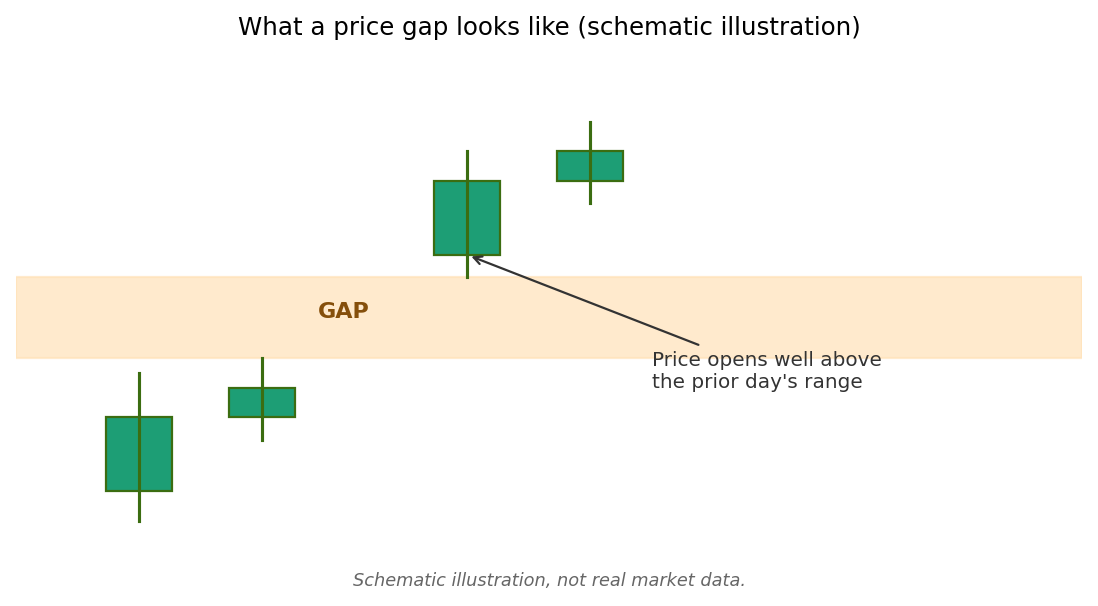
Schematic illustration of a price gap, where the open jumps above the prior session's range.
The schematic above shows the essential shape: a series of candles trading in one range, then a sudden jump to a higher range with a visible empty space, the gap, between them. Gaps can be up or down, and the empty space they leave behind frequently becomes a meaningful technical reference point, since prices sometimes return later to fill the gap, trading back through that empty zone. Understanding the type of gap and the context it occurs in is what separates trading gaps skilfully from gambling on them.
Real gap moves on NVDA
The real NVDA data contains clear examples of the sharp single-day moves and volume spikes that characterize individual stock trading.
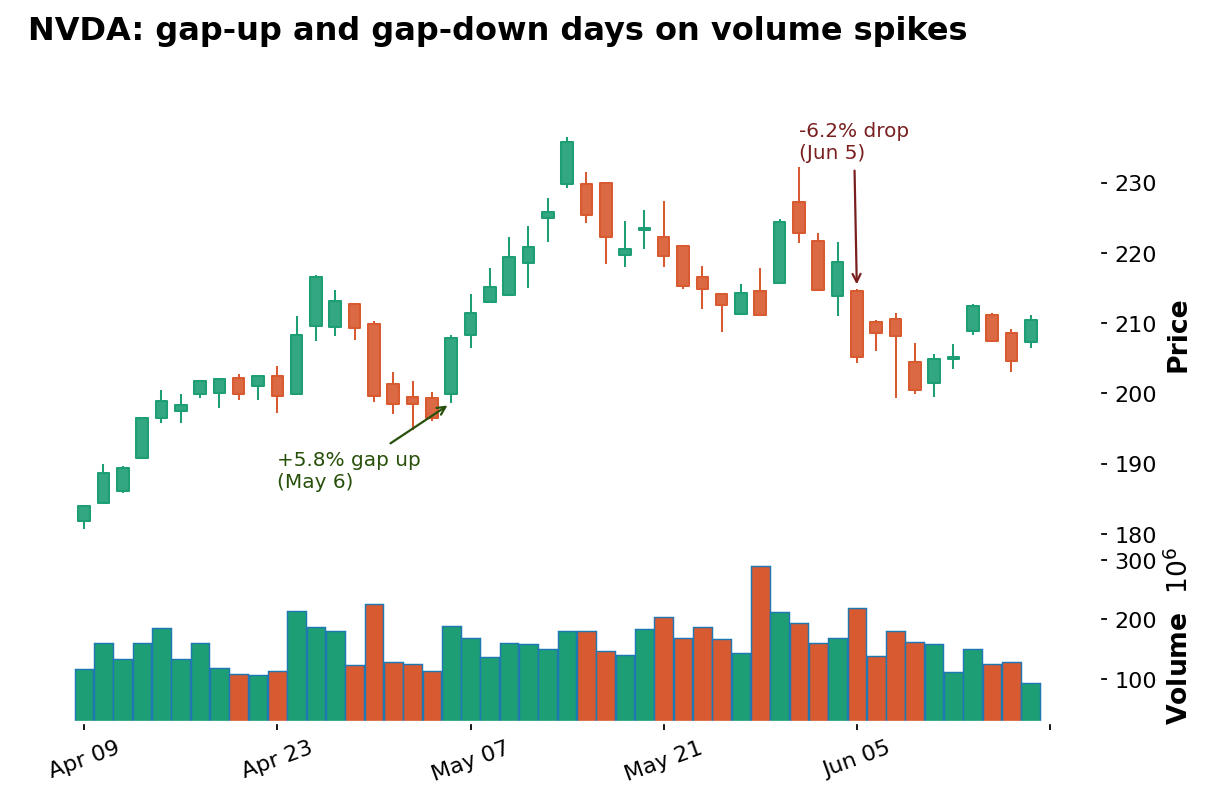
Data: stockanalysis.com (S&P Global), NVDA daily candles with volume, Apr 9 – Jun 18, 2026.
Two moves stand out. On May 6, NVDA surged roughly 5.8 percent in a single session, a powerful up move that helped drive the rally toward the mid-May record high, accompanied by elevated volume reflecting strong buying conviction. Then on June 5, the stock fell about 6.2 percent in one session, on the heaviest volume of that part of the chart, a sharp, decisive down move. These are exactly the kind of large single-day moves that individual stocks produce and that a broad index almost never does. Notice the relationship between the size of each move and the height of its volume bar: the largest moves consistently occur on the largest volume, because big moves are precisely when conviction, and the number of participants trading, spikes. This is the practical heart of volume analysis, and it is why volume spikes are treated as confirmation that a move reflects genuine, broad participation rather than a thin, unreliable drift.
The two faces of a volume spike
A volume spike accompanying a price move can mean two quite different things depending on context, and learning to tell them apart is a genuinely useful intermediate skill. In the middle of a trend, a volume spike on a move in the trend's direction is generally confirming, signaling that the move has broad backing and is likely to continue. But a volume spike after an extended move, especially one that produces a sharp reversal candle, can signal exhaustion, the moment when the last eager buyers (or panicked sellers) finally act and the move runs out of fuel. A massive volume spike on a sharp down day after a long decline, for instance, can mark capitulation, a potential bottoming signal, exactly as discussed in the crypto track. The same volume spike, in other words, is confirming in the middle of a trend and potentially exhausting at its extreme, and context, where the move sits within the larger trend, is what tells you which interpretation applies.
Why gaps are so dangerous to trade carelessly
The defining danger of gaps is that they can leap straight over your stop-loss. Recall from the Foundation risk management article that a stop-loss is meant to cap your loss at a predetermined level. But a stop-loss is only an instruction to sell once the price reaches it, and if a stock gaps down overnight from above your stop to well below it, your order will execute at the much lower opening price, not at your intended stop. This means the actual loss on a gap can be substantially larger than the loss you planned for, which is the single most important risk to understand about holding individual stocks through news events. On the real NVDA chart, a trader holding a position with a stop just below the prior close ahead of the June 5 drop could have suffered a loss well beyond their intended risk, because the stock moved through the stop level decisively rather than pausing there.
Trading around earnings: hold through or step aside
Because earnings reports are the most common cause of large gaps and are scheduled in advance, every trader holding an individual stock faces a recurring decision: hold through the report or step aside before it. Holding through earnings means accepting a binary, hard-to-predict event that can gap the stock sharply in either direction, frequently straight through any stop-loss. Stepping aside before earnings means giving up the chance of a favorable gap in exchange for eliminating the risk of an unfavorable one. Neither choice is universally correct, but the decision should be deliberate and made in advance, not stumbled into by forgetting an earnings date. Many disciplined speculators default to reducing or closing positions before earnings precisely because the outcome is so difficult to anticipate from a chart, and because the gap risk undermines the careful stop-loss discipline that the rest of their process depends on.
Common types of gaps and what they suggest
Technical analysts traditionally distinguish several kinds of gaps by the context in which they appear, and while the categories are interpretive rather than precise, they offer a useful framework. A breakaway gap occurs when price gaps out of a consolidation range or through a major support or resistance level, often signaling the start of a strong new move and accompanied by heavy volume. A runaway or continuation gap appears in the middle of an established trend, reflecting a surge of conviction that carries an existing move further, again typically on strong volume. An exhaustion gap appears near the end of an extended move, a final burst that, rather than continuing, soon reverses, often on climactic volume, marking the move running out of participants. Distinguishing these in real time is genuinely difficult and never certain, but the framework trains a useful habit: rather than reacting to a gap in isolation, you ask where in the larger trend structure it sits, since the same gap means very different things at the start, middle, and end of a move. Volume is one of the most useful clues, as a gap that occurs on unusually heavy volume after a long, extended trend deserves more suspicion of exhaustion than the same gap early in a fresh move.
Why chasing a gap is so tempting and so risky
The psychological pull to chase a gap is powerful and worth naming directly, since it connects to the FOMO covered in the Foundation trading psychology article. When a stock gaps up sharply on good news, the urge to buy immediately, before it runs even higher, can be intense, and it is precisely at the volatile open, when spreads are widest and the move is most extended, that chasing does the most damage. A trader who buys into the first frantic minutes of a gap up frequently ends up with the worst possible entry, buying the high of the day just as early buyers take profits, then watching the stock fade back toward or into the gap. This is why the disciplined approaches to gap trading nearly all involve waiting, for a range to form, for a pullback, for confirmation, rather than chasing the open. The gap itself is information about conviction and sentiment; it is rarely a reason to abandon your entry criteria and buy at any price, and the moments when chasing feels most urgent are typically the moments when it is most dangerous.
Strategies for trading gaps with discipline
For traders who do want to trade gaps deliberately, a few disciplined approaches exist. One is to wait for the gap to establish a clear range in the first part of the session and then trade a breakout from that range, rather than chasing the gap at the open when volatility and spreads are worst. Another is the gap-fill concept: because prices sometimes return to fill the empty space left by a gap, some traders watch for a partial retracement back toward the gap as a potential entry or target. A third is simply to use gaps as information rather than direct trade triggers, treating a strong gap up on heavy volume as confirmation of bullish conviction that supports a trend-following position taken on a subsequent, lower-risk pullback. In every case, the discipline is the same as throughout this series: a predetermined entry, a stop placed where the idea is proven wrong, and a position sized so that even a gap against you, which may exceed your stop, does not cause catastrophic damage.
The unifying theme across gaps and volume spikes is that both are moments of concentrated information. A gap tells you the market repriced the stock sharply on news; a volume spike tells you a large number of participants acted with conviction. Read together and in context, they are among the most honest signals a stock chart provides, since they are difficult to fake and reflect genuine, committed activity. The danger lies entirely in reacting to them carelessly, chasing a gap at the volatile open or assuming a stop-loss will protect you through an earnings report, rather than in the signals themselves, which reward the same patient, disciplined approach as everything else in this series. A trader who internalizes this, treating gaps and volume spikes as high-quality information to be acted on with a plan rather than impulses to be chased, gains access to some of the clearest and most tradeable setups available in individual stocks.
Practical guidelines
Treat a volume spike as confirmation in the middle of a trend, but as a possible exhaustion or capitulation signal at the extreme of an extended move; context decides which.
Understand that a gap can leap straight over your stop-loss, so your actual loss can exceed your planned risk; size positions with that possibility in mind.
Know every earnings date in advance and decide deliberately whether to hold through it or step aside, rather than being caught by surprise.
If trading a gap directly, consider waiting for the post-gap range to form and trading its breakout rather than chasing the volatile open.
Remember the gap-fill tendency: the empty space left by a gap often becomes a meaningful reference level that price may return to later.
Key takeaways
A gap is an empty space on the chart where the stock opened far from its prior close, usually caused by news such as earnings arriving while the market was closed.
The real NVDA data shows a roughly 5.8 percent gap-style surge on May 6 and a 6.2 percent drop on June 5, both on heavy volume, the kind of move an index almost never makes.
Volume spikes confirm a move in the middle of a trend but can signal exhaustion or capitulation at the extreme of an extended move.
Gaps are dangerous because they can leap straight over a stop-loss, making the actual loss larger than planned, which is the key risk of holding stocks through news.
Earnings dates are known in advance, so the choice to hold through or step aside should be deliberate; many disciplined traders reduce exposure before earnings to avoid uncontrolled gap risk.
Disclaimer
This article is for educational purposes only and does not constitute financial or investment advice. The NVDA example used here is real historical data shown for illustration and is not a recommendation to buy or sell any security. The gap diagram is a schematic illustration. Trading around earnings carries elevated, hard-to-predict risk. Always do your own research and consider consulting a licensed financial advisor before trading or investing.