INTERMEDIATE LEVEL
Trading Crypto Volatility in 24/7 Markets
The beginner article in this crypto track established the central fact about cryptocurrency: it moves far more violently than traditional assets, trades around the clock, and is driven heavily by sentiment. This article takes the next step, moving from understanding that volatility to actually trading within it, using the same real iShares Bitcoin Trust (IBIT) data from April to June 2026 that captured a genuine crypto decline. The core message is that crypto's volatility is not simply a danger to be endured; with the right adjustments to the techniques from the Foundation series, it is the very thing that creates opportunity, provided your risk management is built to survive the inevitable sharp moves against you.
Volatility-based position sizing
The single most important adjustment when trading crypto is to size positions according to the asset's volatility rather than treating all assets the same. The Foundation risk management article established that position size equals your maximum dollar risk divided by the distance between entry and stop. In crypto, that stop distance needs to be much wider to avoid being shaken out by ordinary noise, which means the resulting position is automatically smaller for the same dollar risk. This is not a limitation to resent; it is the mechanism that keeps you alive through crypto's larger swings.
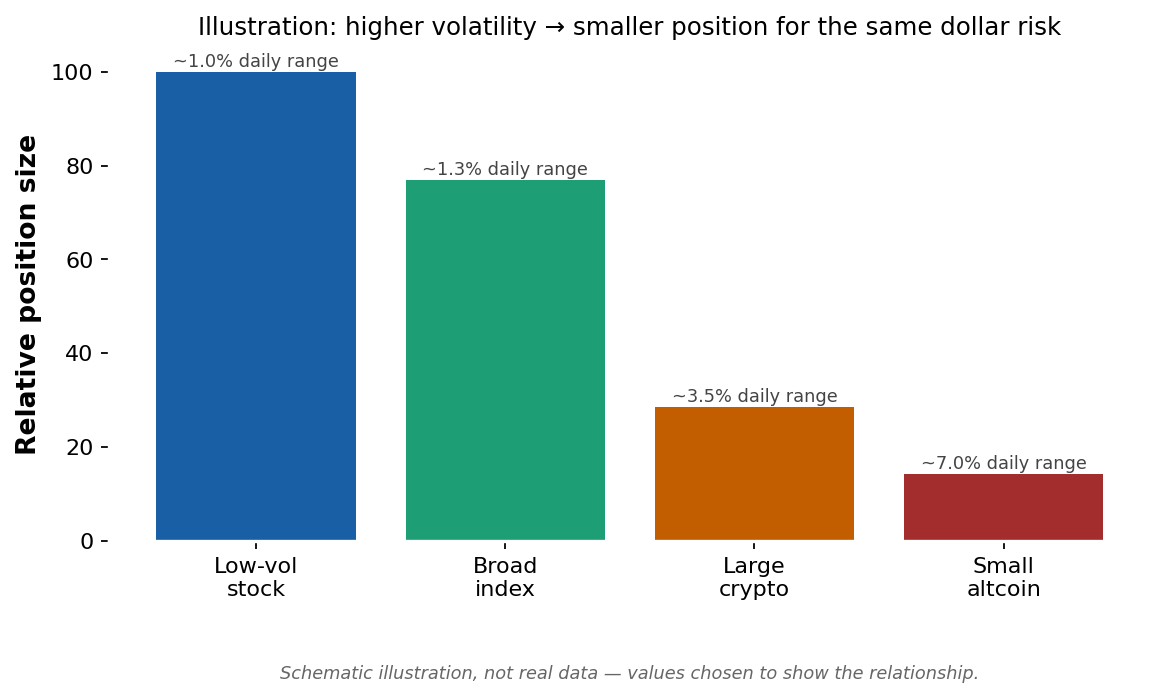
Schematic illustration, not real market data, showing how higher volatility leads to a smaller position for the same fixed dollar risk.
The schematic above illustrates the principle: as an asset's typical daily range increases, from a calm stock through a broad index to a large cryptocurrency and finally to a small, thinly traded altcoin, the appropriate position size for the same fixed dollar risk shrinks accordingly. A common, practical way to implement this is to measure an asset's recent typical daily range, often using an indicator called the Average True Range introduced in the risk management discussion, and place your stop at a multiple of that range beyond your entry. On a highly volatile crypto asset, that multiple-of-range stop will sit far from the entry, correctly forcing a smaller position. A trader who instead used a tight, stock-sized stop on a crypto position would be stopped out constantly by normal volatility, bleeding small losses repeatedly even when their broader directional view was correct.
When support breaks: a real example
One of the most important volatility-driven events to understand is the breakdown of a support level, because in crypto these breakdowns tend to be faster and more severe than in traditional markets, often triggering cascades of selling as stop-losses and forced liquidations pile on. The real IBIT data shows a textbook example.
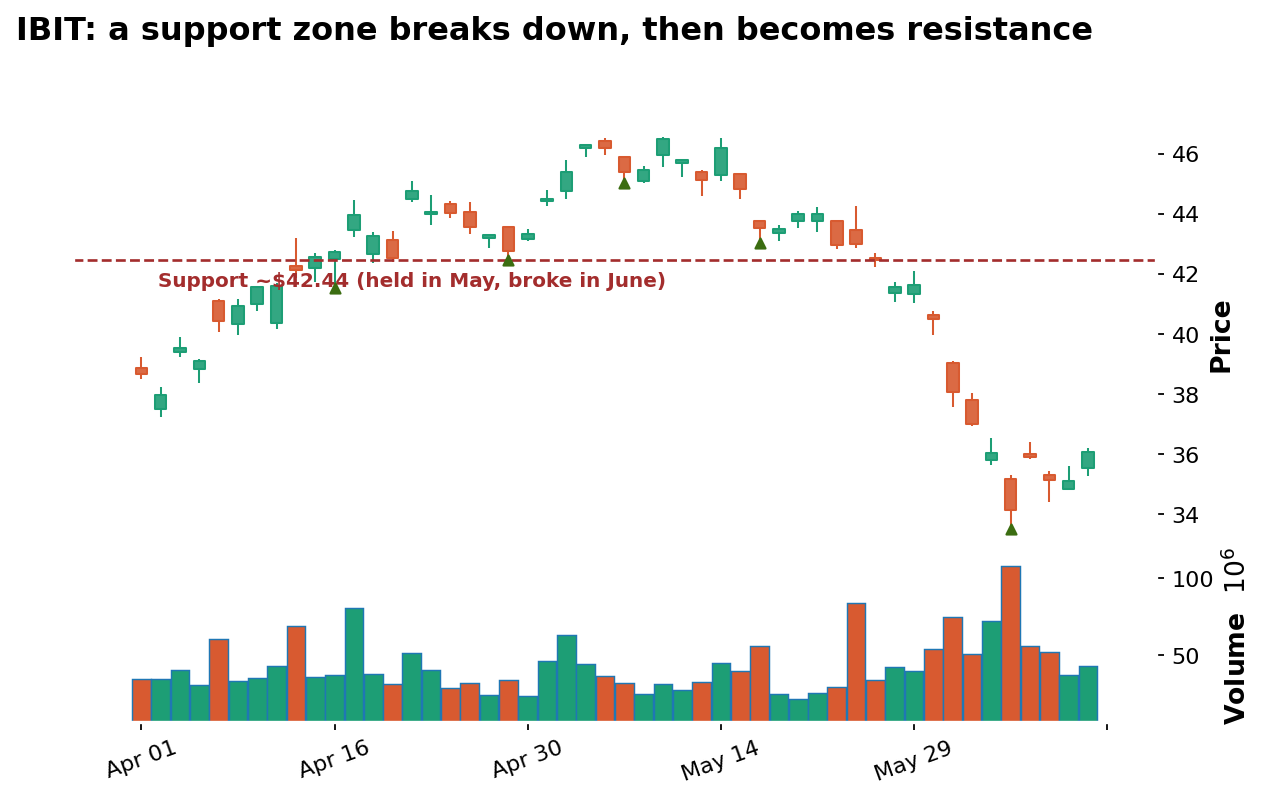
Data: stockanalysis.com (S&P Global), IBIT daily candles, Apr 1 – Jun 11, 2026. Support level derived from real detected swing lows.
The support level drawn here at around $42.44 is not chosen by eye; it sits at the price where the real swing lows clustered, marked by the green triangles, during April and May. For weeks, that zone repeatedly held, with the price dipping toward it and bouncing, exactly the behavior that defines genuine support. Then, in late May and early June, the character changed: the price broke decisively below that support, and rather than finding buyers, the decline accelerated sharply into the June 5 capitulation. This is the crucial volatility lesson. In a calmer market, a support break is often a gradual, orderly affair. In crypto, a support break can turn into a violent cascade, because the same level was being watched by leveraged traders whose positions get force-liquidated when it breaks, adding fuel to the decline. A trader who had been buying that support on the assumption it would hold forever, without a stop-loss positioned just below it, would have been caught in exactly the kind of fast, deep loss crypto is notorious for.
Notice too that once the support broke, the same level would be expected to act as resistance on any subsequent bounce, exactly the role-reversal principle from the Foundation support and resistance article. The level did not stop mattering when it broke; it flipped sides, as broken levels reliably do.
The danger and the mechanics of leverage
Crypto markets are notorious for offering extremely high leverage, sometimes 50 or even 100 times a trader's actual capital, far beyond what is typical or often even legal in regulated stock markets. Leverage magnifies both gains and losses, and in an asset as volatile as crypto, high leverage is one of the fastest known ways to lose an entire account. Consider the arithmetic: on an asset that can fall 5 percent in a single day, as IBIT did on June 5 in the real data above, a trader using 20 times leverage would face a 100 percent loss of their committed capital from that single day's move, wiped out entirely. This is why disciplined crypto speculators treat high leverage with extreme caution or avoid it altogether, and why the position sizing discipline from the Foundation series is not optional here but a survival requirement. Leverage does not create opportunity so much as it compresses the time it takes for crypto's normal volatility to destroy an undisciplined account.
Trading the 24/7 clock
Because the underlying crypto market never closes, volatility can strike at any hour, including overnight and over weekends when most traders are not watching. This has direct, practical implications for how you trade. Hard, automatic stop-loss orders become essential rather than optional, since you cannot manually react to a 3 a.m. cascade. Many crypto traders also pay attention to the fact that liquidity, the ease of buying and selling without moving the price, varies through the global day, often thinning out during certain hours, which can make moves sharper and slippage worse precisely when fewer participants are active. Weekend trading is its own consideration, since lower weekend liquidity can produce exaggerated moves that partially reverse when fuller participation returns during the week. The ETF wrapper used in this article sidesteps some of this by trading only during regular US market hours, but it pays for that convenience by sometimes opening with a large gap that reflects everything that happened in the underlying crypto market while the ETF was closed.
Using volatility as opportunity, not just risk
Everything so far has emphasized defense, and rightly so, because survival comes first. But it is worth being clear that crypto's volatility is also precisely what attracts speculators: the same large swings that can destroy an undisciplined account create, for a disciplined one, frequent opportunities for favorable risk-to-reward setups. A trend that would take a stock index months to complete can play out in crypto in weeks. The wide ranges mean that a well-placed entry near genuine support, with a stop just below it and a target at the next resistance, can offer the kind of 1:2 or 1:3 risk-reward setups discussed in the position sizing article more frequently than a calmer market would. The key word, as always, is disciplined: the volatility rewards traders who respect it with careful sizing and hard stops, and punishes those who treat it as a casino.
Liquidations and the mechanics of a cascade
To trade crypto volatility well, it helps to understand the specific mechanism that makes crypto declines so sharp: the liquidation cascade. A large share of crypto trading happens with borrowed money through leveraged positions, and every leveraged position has a liquidation price at which the exchange automatically closes it to prevent the trader's losses from exceeding their collateral. When the price falls to a zone where many leveraged long positions sit, those positions get force-liquidated, which means they are sold automatically, which pushes the price down further, which triggers the next cluster of liquidations below, and so on in a self-reinforcing cascade. This is why a crypto support break can turn into a near-vertical drop within minutes or hours, far more violent than the orderly breakdowns typical of stock markets. The June capitulation visible in the real data, with its record volume, has the signature of exactly this kind of forced selling. For a trader, the practical lesson is twofold: never sit in a position without a stop just beyond a key level that many others are also watching, and be aware that the very sharpness of a cascade can sometimes mark a short-term exhaustion point, since once the forced sellers are flushed out, the selling pressure can abruptly abate.
Why crypto rewards patience between setups
Crypto's constant motion and round-the-clock nature create a powerful psychological pull toward overtrading, the compulsive taking of marginal setups simply because the market is always open and always moving. This is one of the most common ways crypto traders bleed away capital, since each marginal trade carries real costs in spread and slippage while offering only a weak edge. The discipline of doing nothing, of waiting through long stretches for the few setups that genuinely fit your criteria, is even harder in a market that never closes than in one with a definite end to each session. Experienced crypto traders frequently describe the ability to step away from the screen, precisely because the market's 24/7 nature makes constant watching both possible and exhausting, as one of the most important skills they developed. The market will still be there tomorrow; the goal is to trade the high-quality setups and ignore the noise, not to have an opinion on every move.
It is also worth noting that the ETF wrapper used in this article's examples carries one subtle advantage for risk control that the underlying crypto market does not: because it trades only during regular hours and settles like a normal security, position sizing and stop placement behave in the familiar way a stock trader expects, even though the price it tracks was set around the clock. For traders who find the 24/7 nature of native crypto markets psychologically exhausting, this is a genuine, if partial, benefit, and one reason regulated spot ETFs have drawn participants who want Bitcoin exposure without the relentless pace of the underlying market.
Practical guidelines for trading crypto volatility
Size every position based on the asset's volatility, using a wider, volatility-adjusted stop that automatically produces a smaller position for the same dollar risk.
Always use hard, automatic stop-loss orders, since crypto's 24/7 market means damaging moves frequently happen when you are not watching.
Treat support breaks as potentially violent in crypto, since leveraged liquidations can turn an orderly breakdown into a cascade; never assume a level will hold without a stop just beyond it.
Approach leverage with extreme caution or avoid it entirely; on an asset that can move 5 percent in a day, even modest leverage can wipe out an account from a single session.
Remember that broken support becomes resistance and broken resistance becomes support, exactly as in traditional markets, so a level that fails still matters on the subsequent move.
The expert article in this crypto track adds a final dimension that genuinely has no equivalent in traditional markets: on-chain data, the public, transparent record of activity on the blockchain itself, and how it can be combined with the price-based technical analysis covered here and throughout the series.
Key takeaways
Crypto's volatility requires wider, volatility-adjusted stops, which automatically produce smaller positions for the same fixed dollar risk, the mechanism that keeps an account alive.
The real IBIT data shows a genuine support zone near $42.44 holding for weeks in April and May, then breaking down into an accelerating June decline, a textbook crypto support cascade.
Support breaks in crypto can be violent because leveraged liquidations pile onto the move, which is why a stop-loss positioned just beyond a key level is essential.
High leverage is extremely dangerous in crypto, since an asset that can fall 5 percent in a day can wipe out a leveraged account from a single session.
Crypto's volatility is also the source of opportunity: with disciplined sizing and hard stops, its wide ranges create frequent favorable risk-to-reward setups.
Disclaimer
This article is for educational purposes only and does not constitute financial or investment advice. Cryptocurrency is a highly volatile and speculative asset class, and you should never invest more than you can afford to lose entirely. The IBIT example used here is real historical data shown for illustration and is not a recommendation to buy or sell any security or cryptocurrency. The position-sizing diagram is a schematic illustration, not real market data. Always do your own research and consider consulting a licensed financial advisor before trading or investing.