
BEGINNER LEVEL
If you show a hundred different traders the same chart with no labels and no indicators, a striking number of them will independently draw very similar lines across it. Those lines mark support and resistance, the single most widely used concept in technical analysis and very likely the first real skill you should build before touching any indicator. Everything else in this series, moving averages, RSI, chart patterns, even risk management, becomes easier to understand once you can reliably spot these levels yourself.
What support and resistance actually are
Support is a price level where, historically, buying pressure has been strong enough to repeatedly stop a decline and turn it back upward. Think of it as a floor: the price falls toward it, finds enough buyers willing to step in at that level, and bounces. Resistance is the mirror image, a price level where selling pressure has repeatedly been strong enough to stop a rally and turn it back downward, acting like a ceiling.
These levels exist because large numbers of market participants tend to make similar decisions around similar prices. Some investors set a mental or literal limit order to buy if a stock falls to a price they consider attractive, clustering buy orders at a specific level. Others decide in advance that they will take profits or cut a short position if a price rises to a level they view as expensive, clustering sell orders at another specific level. Because so many participants are watching the same obvious price points, often the prior peaks and troughs visible on a chart, those levels become self-reinforcing: traders see the level, react to it, and in doing so help create the very behavior they were anticipating.
Spotting real support and resistance: a worked example
Theory is easy. Spotting these levels on a real, messy chart in real time is the actual skill, so let’s use the same genuine AAPL daily data from July 22 to September 30, 2025, that opened this series.
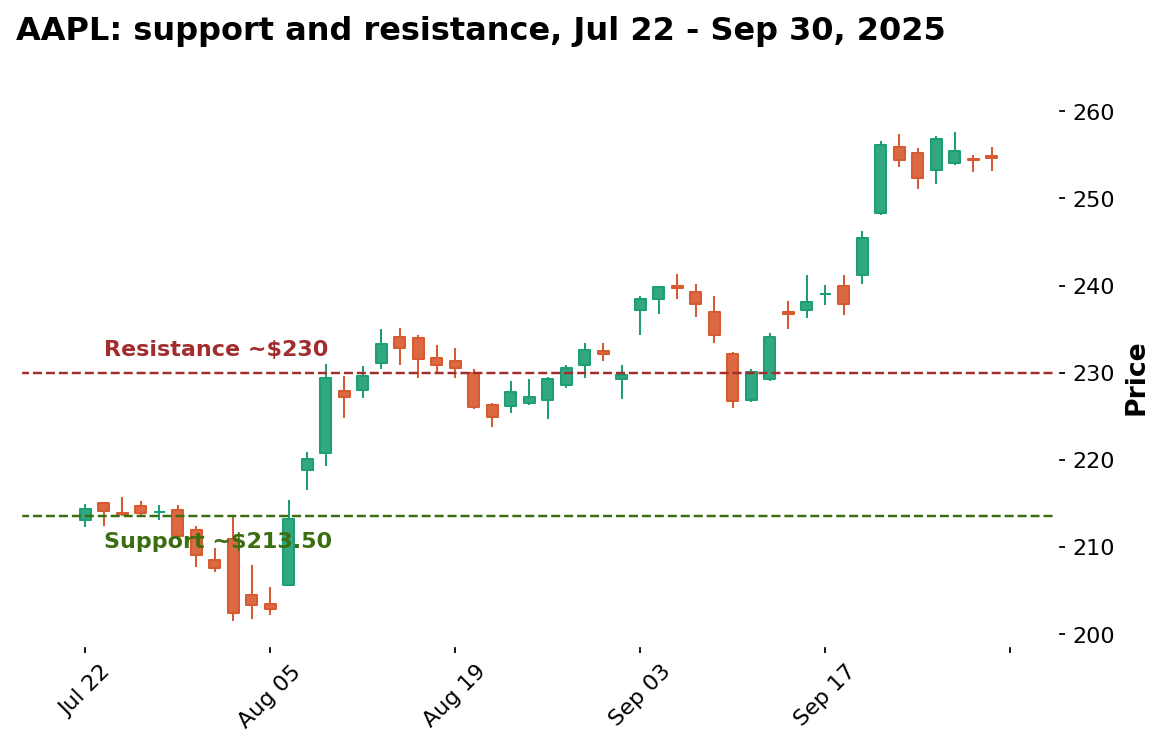
Data: TipRanks historical prices, AAPL daily candles, Jul 22 – Sep 30, 2025.
Two levels stand out clearly on this real chart. Around $213.50, the price found buyers on multiple occasions in the back half of July, refusing to fall much further; that zone acted as support during that stretch. Around $230, the price ran into repeated selling during mid-August, topping out near that level on August 13 and 14 before drifting back down, and again struggling to clear it decisively through most of late August; that zone acted as resistance.
Notice what happened by mid-September: once the price finally broke convincingly above the $230 resistance zone (helped along by the strong September 19 and September 22 sessions), it never looked back during the remainder of this window, closing the period above $254. This is the single most important practical lesson about these levels: when a resistance level is decisively broken, it frequently flips and becomes a new support level on subsequent pullbacks, because the traders who regretted not buying at $230 the first time are often eager to buy a dip back toward that level afterward. The reverse is equally true; broken support often becomes new resistance.
How to actually draw these lines yourself
Start by zooming out to a timeframe that shows at least a few months of price history. Look for price levels where the chart has clearly turned more than once, not just a single sharp spike that immediately reversed, but a level the price has approached, paused at, and reversed from on at least two separate occasions. A level tested only once is a curiosity; a level tested three or four times is a real support or resistance zone worth marking.
Resist the temptation to draw a perfectly precise single-price line. Real markets rarely respect a level down to the exact cent. It is far more useful to think of support and resistance as zones, often a percent or two wide, rather than a single mathematically exact number. On the AAPL chart above, the resistance was not exactly $230.00 every single time; it showed up anywhere from about $229 to $233 across different sessions, and treating it as a zone rather than a precise line would have kept you from being confused when price poked slightly above or below the round number without truly breaking out.
Why these levels matter for speculation
Support and resistance give a speculator three immediately practical things. First, they suggest entry zones: buying near support in an uptrend, or near resistance if you are betting on a reversal lower, generally offers a better risk-to-reward setup than buying in the middle of nowhere on the chart. Second, they suggest logical places for a stop-loss, since a clean break through a support zone is meaningful evidence that your original thesis was wrong, which is far more useful than picking an arbitrary stop price out of thin air. Third, they suggest profit targets, since the next resistance zone above an entry is a natural place to expect selling pressure to reappear and a sensible point to consider locking in gains.
We will use this exact logic when we get to risk management later in this series, where the actual entry, stop, and target on a real AAPL trade idea are built directly from levels like the ones identified here.
Common mistakes beginners make with these levels
- Treating every minor wiggle as a new support or resistance level. A level only earns the name once price has reacted to it more than once; one bounce could simply be noise.
- Expecting a level to hold forever. Levels are probabilities built from history, not guarantees. Eventually, with enough pressure, almost every level breaks.
- Drawing lines too precisely. A support zone identified to the exact cent will make you doubt yourself the moment price undershoots it slightly and still bounces.
- Ignoring the size of the move into a level. A level reached after a slow, gradual drift behaves differently than one reached after a violent, panicked plunge; the latter is more likely to overshoot before reversing.
- Forgetting that broken levels tend to switch roles. Many beginners keep watching an old resistance level as resistance even after price has closed convincingly above it and the level has flipped to support.
Round numbers and psychological levels
A special case of resistance and support worth calling out on its own is the psychological round number. Prices ending in a clean round figure, $100, $200, $230, $250, tend to attract a disproportionate number of orders simply because round numbers are easier for human beings to remember, set alerts at, and use as mental anchors when deciding where to place a limit order. This is not a mystical property of the number itself; it is a direct consequence of how people think. The real AAPL data used in this article shows this clearly: the stock approached the psychologically significant $250 level in late September, and while it pushed through it without much hesitation given the strength of that breakout, you will find on many other charts, across many other assets, that round numbers cause a brief pause or a small reversal even when no obvious prior price history explains why that exact level should matter.
This matters practically because it gives you a second, independent way to anticipate where a support or resistance zone might form even on an asset or a time period where you do not yet have much prior price history to draw from. A newly listed stock or a freshly launched cryptocurrency, with no real trading history, will still tend to react to clean round numbers in its price, simply because new participants entering the market gravitate toward those same easy mental anchors that everyone else is using.
How this concept shows up differently across markets
Although support and resistance is genuinely a universal concept, the specific texture of how it appears does shift somewhat between asset classes, a theme this series will return to in more depth in dedicated market-specific articles later on. In forex, round numbers tend to appear at clean pip levels, for example 1.1000 on EUR/USD, and these levels often coincide with large standing institutional orders that are publicly known to cluster there. In gold, psychological round numbers like $2,000 or $2,500 per ounce have historically acted as significant magnets for price, often debated extensively in financial media precisely because so many market participants are watching the same level simultaneously. In cryptocurrency markets, round numbers like $50,000 or $100,000 for bitcoin function almost identically, frequently becoming the subject of widespread public attention that itself reinforces the level’s importance, a feedback loop that is somewhat less pronounced in more mature, less retail-dominated markets like large-cap stocks.
A simple practice routine for building this skill
Like any chart-reading skill, recognizing genuine support and resistance reliably takes repetition, not just reading about the concept once. A useful exercise is to pull up twenty or thirty historical charts across different assets, cover the right-hand portion of each chart so you cannot see what happened next, mark where you believe the next support or resistance reaction is likely to occur based only on the visible history, and then reveal the rest of the chart to check your work. Doing this consistently, even for fifteen minutes a day over a few weeks, builds an intuitive feel for these levels far faster than reading definitions alone, and it directly mirrors the real, working method used to identify the $213.50 and $230 levels on the AAPL chart earlier in this article.
False breakouts and how to filter them
Not every push through a support or resistance level is genuine, and false breakouts, sometimes called fakeouts, are one of the most common ways this concept costs beginners money. A false breakout occurs when price pokes briefly above resistance or below support, triggering breakout traders into new positions, only to reverse back inside the prior range shortly afterward, leaving those traders with a loss almost immediately. A widely used filter against this is waiting for a candle to close beyond the level, rather than reacting to any intraday touch, since a close represents where buyers and sellers actually settled for that period rather than a fleeting, temporary excursion. Requiring a second candle to hold beyond the level before acting, sometimes called a retest confirmation, filters out an even larger share of false breakouts, at the cost of entering somewhat later and capturing a smaller portion of the subsequent move. On the AAPL chart in this article, the break above $230 in September was confirmed by several consecutive closes well above the level rather than a single brief poke through it, which is part of why that particular breakout proved genuine rather than a fakeout that quickly failed.
It is also worth noting that support and resistance levels carry more weight when multiple, independent forms of evidence point to the same price. A level that coincides with a prior swing high, a round number, and a moving average all at once is generally more significant than a level identified from price history alone, a theme this series will revisit explicitly once moving averages are introduced.
Key takeaways
- Support is a price floor where buying pressure has repeatedly stopped declines; resistance is a price ceiling where selling pressure has repeatedly stopped rallies.
- These levels form because large numbers of traders make similar decisions around the same visible price points, which makes the levels self-reinforcing.
- On the real AAPL data from Jul 22 to Sep 30, 2025, roughly $213.50 acted as support in late July and roughly $230 acted as resistance through mid-to-late August, until price broke through it decisively in September.
- Treat support and resistance as zones a percent or two wide rather than exact prices, and require at least two genuine tests before trusting a level.
- A decisively broken resistance level often becomes new support, and a decisively broken support level often becomes new resistance.
Disclaimer
This article is for educational purposes only and does not constitute financial or investment advice. Support and resistance levels are based on historical price behavior and are not guaranteed to hold in the future. The AAPL example used here is real historical data shown for illustration and is not a recommendation to buy or sell any security. Always do your own research and consider consulting a licensed financial advisor before trading or investing.
Leave a Reply