
BEGINNER LEVEL
Risk Management Basics: Protecting Your Capital Before You Trade
Ask a hundred profitable speculators what separates them from the traders who blow up their accounts, and the honest ones will rarely point to a secret indicator or a perfect entry technique. They will point to risk management: the unglamorous discipline of deciding, before you ever place a trade, exactly how much you are willing to lose if you are wrong. Every article so far in this series has been about finding good opportunities. This one is about surviving the opportunities that do not work out, because some of them never will, no matter how good your analysis is.
The examples here use real daily data from the SPDR S&P 500 ETF, ticker SPY, which tracks the S&P 500 index, covering April and May 2026 and sourced from public market records.
Why this comes before strategy, not after
It is tempting to treat risk management as a final, optional step you add once you already have a winning strategy. In practice it has to come first, because even a genuinely good strategy with a positive average outcome over many trades will still produce a string of losses sometimes, simply due to the randomness of when good setups happen to fail. A trader without a risk management plan who hits that losing streak right after starting often gets wiped out, or panics and abandons a strategy that was actually working, before the law of averages has a chance to play out.
The three numbers every trade needs before you enter
Professional risk management boils down to defining three prices before you risk a single dollar: your entry, the exact price you stop yourself out if you are wrong, and the target where you plan to take profit if you are right. Skipping any one of these and figuring it out later, in the heat of the moment while a position moves against you, is one of the most reliable ways to turn a small, planned loss into a large, unplanned one.
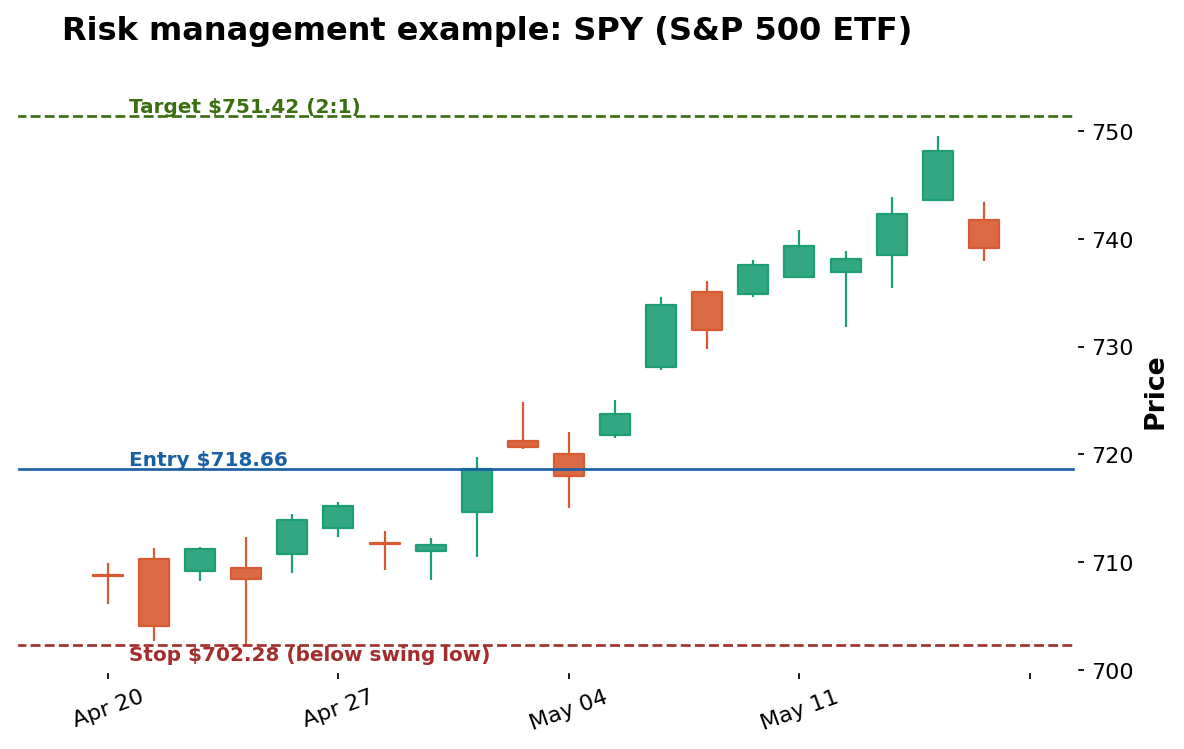
Data: stockanalysis.com (Tiingo), SPY daily candles, Apr 20 – May 15, 2026. Stop placed below the real Apr 23 swing low.
This real SPY example shows the logic concretely. After a pullback within the broader April uptrend, SPY closed at $718.66 on April 30. A trader entering here, expecting the uptrend to continue, could place a stop just below the most recent meaningful swing low at $702.28, the real low from April 23, a level that would only be reached if the bullish thesis were clearly wrong. That defines the risk: $16.38 per share. Using a 2:1 reward-to-risk ratio, a common starting point covered in detail in a later article, the target becomes $718.66 plus $32.76, or $751.42. As it happened in this real example, SPY did reach that target zone within about two weeks, trading above $748 by mid-May and pushing past $751 shortly after, though real markets do not always cooperate this neatly, and plenty of equally well-reasoned setups end at the stop instead.
Why the stop-loss is non-negotiable
A stop-loss is a predetermined price at which you exit a losing position, no exceptions, no second-guessing once price reaches it. Its entire value comes from being decided in advance, while you are calm and objective, rather than in the moment, when the natural human instinct is to hope a losing position will turn around if you just wait a little longer. That instinct, called loss aversion by behavioral economists, is one of the most consistently damaging biases in speculation, and a hard stop-loss is the simplest known defense against it.
A good stop-loss is not picked using an arbitrary percentage or a comfortable round number. It is placed at a level where, if reached, your original reason for entering is demonstrably no longer valid, often just beyond a relevant support or resistance level from earlier in this series, exactly as the $702.28 stop sat just below a real prior swing low in the example above. A stop placed too tight gets triggered by ordinary market noise before your thesis has a chance to play out; a stop placed too loose risks far more capital than necessary on a single idea.
How much of your account to risk on any single trade
A widely used starting guideline among disciplined speculators is to risk no more than one to two percent of total trading capital on any single position. On a $10,000 account, that means a maximum loss of $100 to $200 if a trade hits its stop, regardless of how confident you feel. This is not timidity; it is survival math. A trader risking two percent per trade needs roughly 35 consecutive losing trades to halve their account, an extremely unlikely outcome for any reasonable strategy. A trader risking twenty percent per trade only needs about three or four consecutive losses, a streak that ordinary bad luck delivers far more often than most beginners expect.
Position sizing in one sentence
Once you know your maximum dollar risk per trade and the distance, in price, between your entry and your stop, position size is simple division: maximum dollar risk divided by the per-share or per-unit risk tells you how many shares, lots, or units to trade. In the SPY example above, a trader with a $10,000 account risking one percent, or $100, with a per-share risk of $16.38 between the $718.66 entry and the $702.28 stop, could buy approximately 6 shares ($100 divided by $16.38), not an arbitrary round number chosen because it felt right. Because SPY trades at a high per-share price with a wide stop distance here, the position is naturally small; the next article covers position sizing and reward-to-risk ratios in far more depth, including how this number changes as your stop distance changes.
Hard stops, mental stops, and trailing stops
A hard stop is an actual order placed with your broker in advance, set to trigger automatically the instant price reaches your level, regardless of whether you are watching. A mental stop is a level you have decided on but not entered as a live order, planning to exit manually. Mental stops are consistently less reliable, because they require you to act decisively in the exact moment loss aversion is working hardest against you. Beginners are far better served by hard, automatic stops until they have a demonstrated track record of honoring mental stops without exception. A trailing stop is a more advanced variation that moves automatically in your favor as a winning trade progresses, locking in a portion of unrealized gains; on the real SPY move above, a trailing stop might have ridden the position past the original $751 target as the rally continued, trading a known fixed reward for an uncertain, potentially larger one.
Correlation risk: why five trades are not always five separate risks
A subtle mistake even careful traders make is ignoring correlation between positions. If you risk one percent on a long SPY position and simultaneously one percent on a long QQQ position, you are not genuinely diversified across two independent risks; SPY and QQQ overlap heavily in their largest holdings and tend to move together, so you are closer to a single combined two-percent risk on the broad US market, because both positions are likely to hit their stops together in a sharp market-wide downturn, exactly like the June 5 plunge that hit both ETFs at once. A practical defense is to consciously total up your exposure to a single underlying theme across all open positions, not just position by position, before adding a new trade that shares that same driver.
Volatility-adjusted stops
Placing a stop just beyond a support or resistance level, as in the SPY example above, works well most of the time, but it can place a stop too close on an asset that simply moves a lot from day to day as a matter of normal behavior. A widely used refinement accounts for an asset's typical daily range, often measured with an indicator called the Average True Range, and sets the stop at a multiple of that typical range beyond the entry, rather than relying purely on the nearest visible chart level. An asset with a large typical daily range needs proportionally more breathing room in its stop than a calmer, low-volatility one, or ordinary day-to-day noise will trigger the stop long before the original thesis has been given a fair chance. This refinement does not replace level-based placement; experienced traders frequently use both together, choosing a level near a genuine support or resistance zone, then checking that the resulting distance is not unreasonably tight relative to the asset's normal volatility before finalizing the stop. The early-June volatility in this series' data, where daily ranges expanded sharply, is exactly the kind of environment where a stop sized only to a calm-market level would have been far too tight.
Why surviving matters more than being right
It is worth stating plainly the philosophy underneath all of this. A speculator's first job is not to be right; it is to survive long enough for being right, on average, to matter. A trader who is correct on 60 percent of trades but occasionally risks half the account on a single idea will eventually meet the losing streak that ends them, while a trader who is correct only 45 percent of the time but never risks more than one percent per trade can compound steadily for years. This is why risk management is the foundation the rest of this series is built on rather than an afterthought: every technique for finding good trades is only valuable if you are still in the game to use it after an inevitable run of losses, and the single fastest way out of the game is sizing positions too large relative to the account.
Common risk management mistakes
Moving a stop-loss further away once price approaches it, turning a planned small loss into an unplanned larger one out of hope rather than analysis.
Sizing a position based on conviction rather than the distance to the stop. A trade you feel confident about still deserves the same percentage risk as any other.
Risking a large percentage of capital on a single idea because a losing streak feels statistically unlikely right after a string of wins. Losing streaks do not respect how recently you won.
Entering a position with no predetermined target, which often leads to selling winners too early out of fear or holding them too long out of greed.
Treating risk management as something to set up only after becoming profitable, rather than as the foundation that makes consistent profitability possible in the first place.
Finally, write your risk management rules down somewhere you will actually see them before every trade. A one-page personal checklist covering maximum risk per trade, maximum correlated exposure, and your stop-placement method takes only a few minutes to create and consistently catches the small, avoidable mistakes that compound into serious account damage over many months.
None of these techniques require predicting the market correctly more often than not. They require surviving the times you are wrong cheaply enough that the times you are right can still add up to genuine, durable progress.
Key takeaways
Define your entry, stop-loss, and profit target before placing any trade, not after.
A stop-loss only works if it is honored without exception; its value comes from being decided in advance while you are calm, and from sitting just beyond a level that would prove your thesis wrong.
Risking one to two percent of total capital per trade is a widely used guideline that protects against realistic losing streaks.
Position size is calculated, not guessed: maximum dollar risk divided by the per-unit distance between entry and stop. In the real SPY example, a $718.66 entry and $702.28 stop gave a $16.38 risk per share.
SPY and QQQ overlap heavily and tend to move together, so treating long positions in both as independent risks understates your true exposure to a broad market decline.
Disclaimer
This article is for educational purposes only and does not constitute financial or investment advice. The entry, stop, and target levels discussed here are illustrative examples based on real historical SPY data and are not a recommendation to buy or sell any security. Always do your own research and consider consulting a licensed financial advisor before trading or investing.